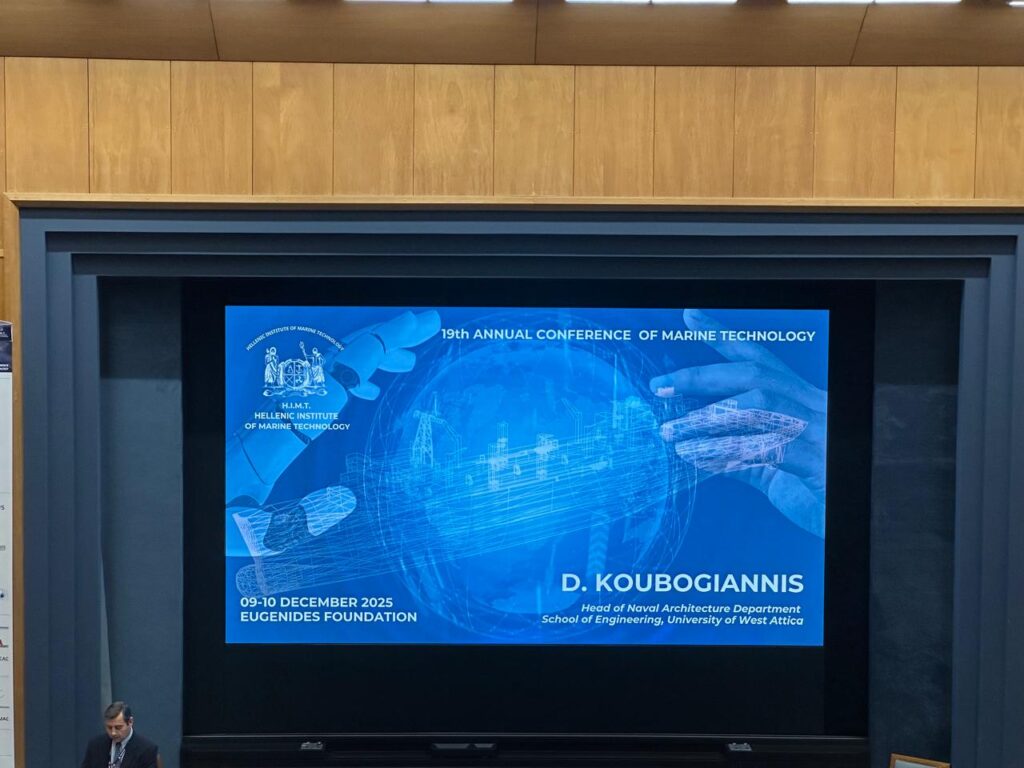
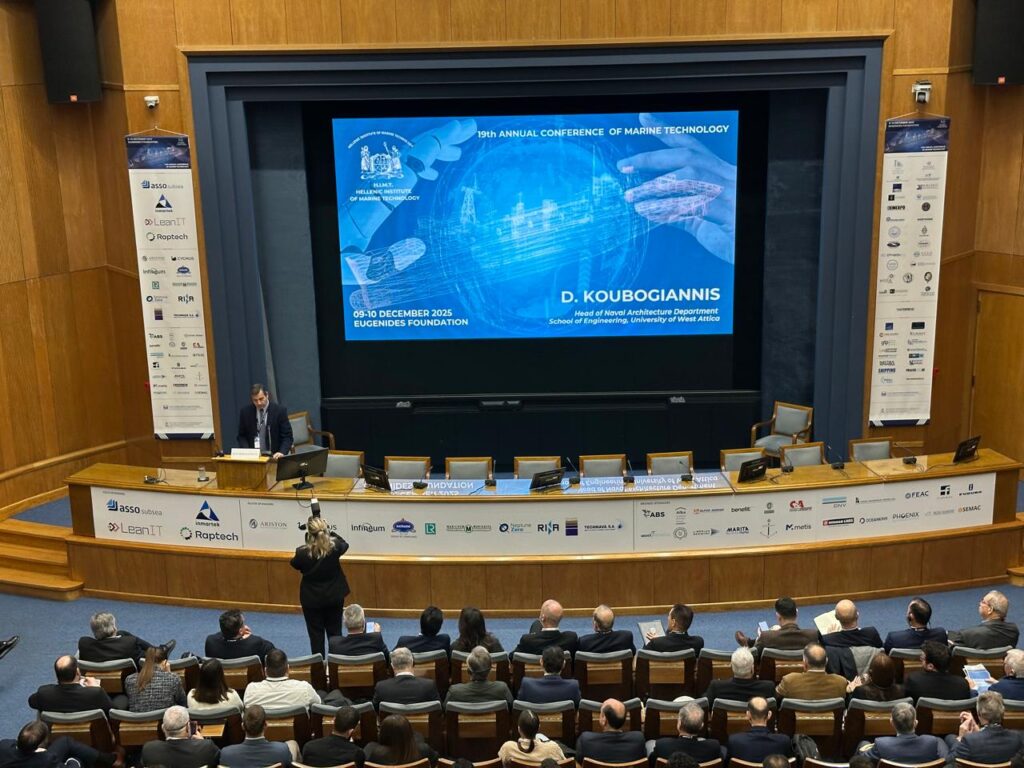
SKYLD Security and Defence Ltd participated in the 19th Annual Conference of Marine Technology (H.I.M.T.), held on 9–10 December 2025 at the Eugenides Foundation in Athens. Our purpose was simple and practical: listen, learn, and connect—to understand where maritime technology is heading and to explore meaningful paths for future collaboration and exploitation with ship owners, managers, yards, integrators, and research stakeholders.
Across the sessions and discussions, one message came through clearly: shipping is moving fast toward data-led operations, where reliability, availability, and maintenance planning are increasingly driven by continuous monitoring, smarter analytics, and decision support. The industry conversation is no longer just about collecting more signals—it’s about turning those signals into timely, trusted actions that can be used onboard and onshore.
What we were looking for at H.I.M.T.
Our focus during the conference was to capture the real-world “signals” behind the buzzwords:
- How stakeholders define value in condition-based maintenance and predictive maintenance
- Where the market is heading on machinery and hull/structural health monitoring
- What owners and operators expect from decision support tools and “human-friendly” interfaces
- Where the practical barriers still sit (integration effort, data quality, connectivity constraints, cyber considerations, and operational workflows)
Why this matters for MHUMS
SKYLD attended the conference in direct connection to our coordination and R&D work on MHUMS (Maritime Health Usage and Monitoring System)—a proposal and technology direction aiming to improve vessels’ operational capability by advancing the utilisation of data from modern monitoring systems and innovatively upgrading how that data is interpreted.
MHUMS targets key areas that stakeholders repeatedly care about in day-to-day operations:
- Machinery, communications, and hull/structural health monitoring, supported by modern data science (including AI/ML)
- Optimal sensor placement and networking, to improve visibility without creating unnecessary complexity
- Computational modelling and lifetime extension, supporting decisions that are not only reactive but planned and justified
- Damage detection, diagnosis, and prognosis, to help reduce unforeseen breakdowns and prevent escalation into difficult operational developments
- A Virtual Assistant (VA) environment (chatbot-style) that can quickly retrieve, filter, and interpret information from MHUMS databases, and—when required—provide guidance that supports decision-making
At its core, MHUMS is about delivering a HUM-system that can provide reliable status information to the ship captain and to the ship owner/management company—at any time and in any situation—while also strengthening maintenance planning and supporting smarter interventions.
What comes next
Our participation in H.I.M.T. 2025 is part of SKYLD’s broader effort to stay close to operational needs and real stakeholder priorities. The conversations we had in Athens will directly inform how we shape MHUMS exploitation thinking: who benefits first, what integration approach is realistic, and how we package value in a way that fits the workflows of ship operators and technical teams.
If you are interested in discussing maritime health monitoring, AI-enabled maintenance planning, or decision support for fleet operations, we’d be happy to connect.
MHUMS project page: https://mhums.skyld.com.cy/
Acknowledgement: MHUMS is co-funded by the Research and Innovation Foundation (RIF) (Cyprus).