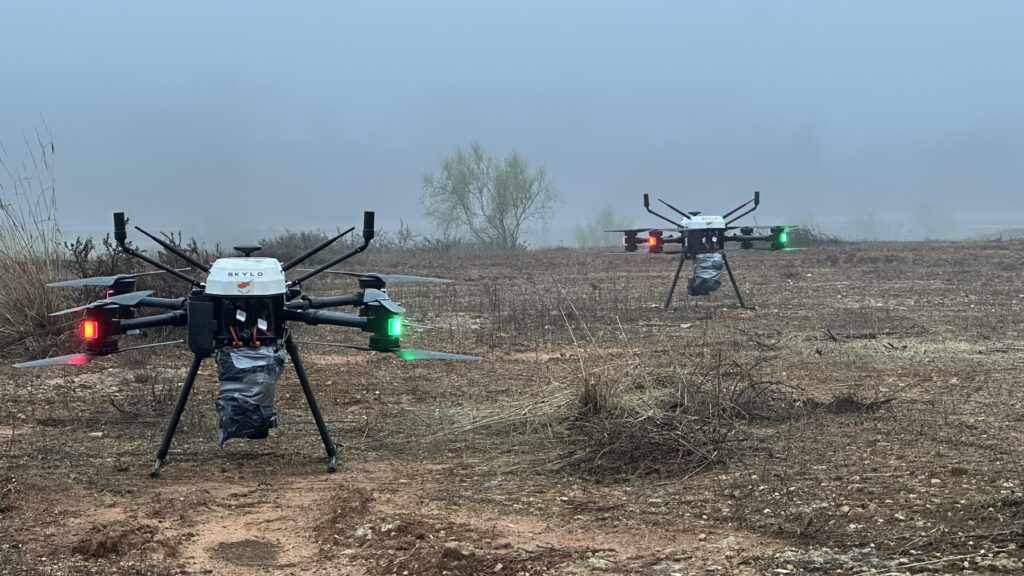
After three years of collaborative research and development, the COMMANDS project has concluded successfully, marking an important step forward for European defence innovation and operational capability in manned–unmanned teaming.
COMMANDS brought together a strong European consortium to develop and demonstrate integrated capabilities that support safer, more effective convoy operations and mission execution in complex environments. The project culminated with a final capability demonstration in Seville, Spain, hosted by consortium partner GDELS Santa Bárbara Sistemas, showcasing the outcomes achieved across the programme.
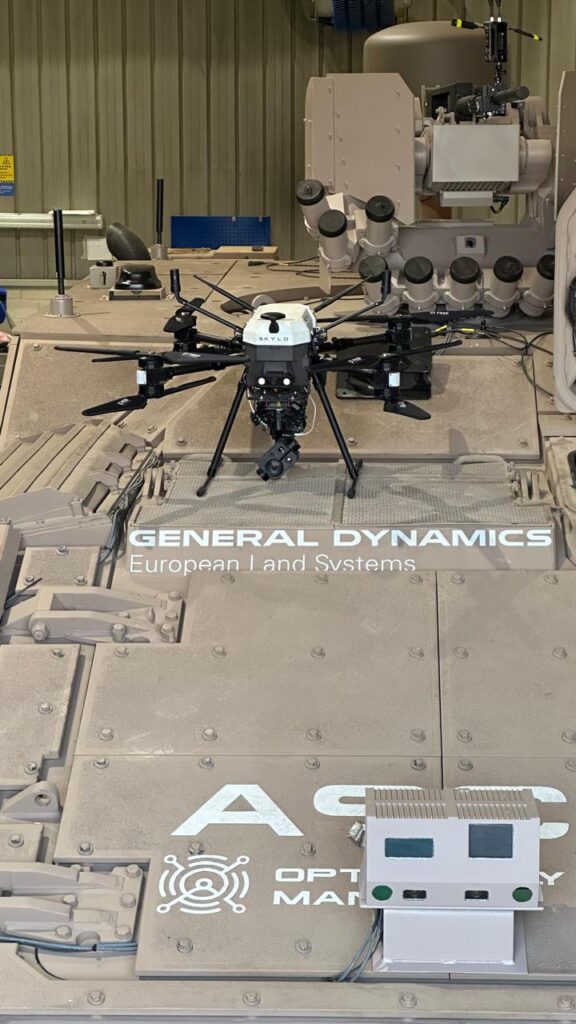
SKYLD’s contribution in COMMANDS
Within COMMANDS, SKYLD Security and Defence Ltd delivered an Autonomous UAV Swarm capability designed to enhance reconnaissance and target support in operational scenarios.
At the core of SKYLD’s contribution was a next-generation autonomous UAV ecosystem built around our Swarm Engine, enabling coordinated multi-UAV behaviour through:
- Coordinated task allocation across multiple UAVs, supporting efficient mission execution and coverage
- Guidance & control functions designed for cooperative autonomy
- Multi-sensor data fusion, improving situational understanding and the quality of insights delivered to operators
To strengthen operational value, SKYLD also implemented AI-enabled edge processing of EO/IR streams, supporting rapid detection and alerting for mission-relevant observations. Combined with multi-UAV cooperation, this provides practical benefits such as improved scanning efficiency and autonomous behaviours that help operators maintain awareness and respond faster.
Interoperability with the wider command environment
A key objective in COMMANDS was that unmanned capabilities do not operate in isolation. SKYLD’s swarm capability was designed to integrate with the broader command and control ecosystem through interoperability with a Battle Management System (BMS) using STANAG 4586 / standardized messaging, supporting secure information exchange and consistent operational workflows.
This integration approach helps ensure that swarm-derived outputs can be consumed within existing command structures, reducing operational friction and improving usability during live missions.
Ground Control Station for mission planning and real-time command
To support commanders and operators, SKYLD developed a dedicated Ground Control Station (GCS) enabling:
- Mission planning for swarm-enabled operations
- Real-time command and control
- Operational visualization to help users understand what the swarm is doing and why
During the project, SKYLD’s contribution was demonstrated using the ZEUS UAV platform as part of the wider system-of-systems capability showcased by the consortium.
Delivering capability through collaboration
COMMANDS reaffirmed the importance of European cooperation in accelerating defence technology maturity—from concept and integration through to demonstration. SKYLD is proud to have contributed to a programme that advances practical autonomy, interoperability, and operational readiness in support of Europe’s strategic goals.
We congratulate the full COMMANDS consortium on the project’s completion and thank all partners and stakeholders for the collaboration throughout the project lifecycle.